It’s the End of the World as We Know it (And I Feel Fine)
The broken-system paradox of voting
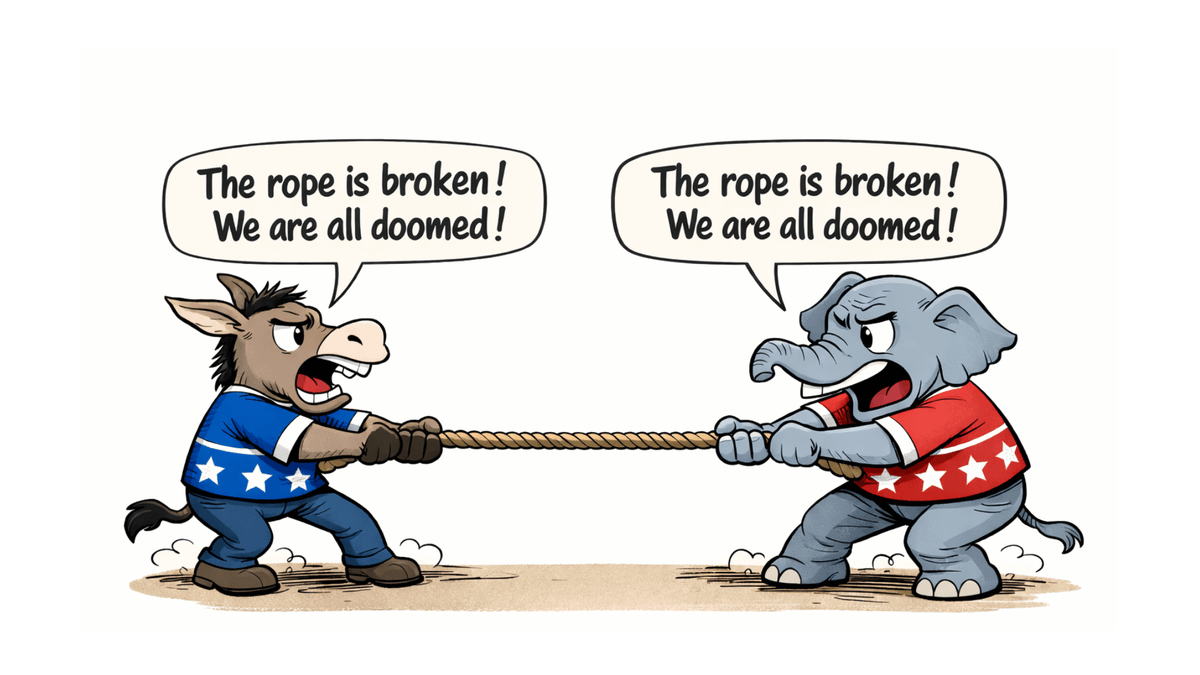
The broken-system paradox of voting
R.E.M.'s song "It's the End of the World as We Know It (And I Feel Fine)" was written in 1987 and was released as the lead single from their fifth studio album "Document" on September 27, 1987. The song is considered a classic of the band's catalog and one of their most well-known songs, and it is still played on radio and covered by other artists today. The song is about the end of the world, duh, as suggested by the title. The song's lyrics express the feeling of being overwhelmed by the rapid changes happening in the world, the constant stream of information, and the feeling of being detached from it all. This was in 1987! It’s so much worse now. The song also highlights the feeling of being unable to make sense of the world and the idea that everything is falling apart. The song's lyrics also include a sense of acceptance of the world's chaos, and the title reflects the idea that the end of the world is not something to be feared, but something to be embraced.
Full stack voting is simple but it’s not easy– it will always feel like it’s the end of the world in election politics, our job is to remember we can feel just fine about it. The specific historical events and pop culture figures from the R.E.M. song are not relevant today, but the sentiment is. Politicians, candidates, and campaigns are determined to convince voters that the end of the world is approaching unless you rise and give them power (vote for them!). It always been that way. If citizens perceive that the outcome of the election will have a significant impact on their lives, they are more likely to vote. The partisans will tell you this next election is the most important in history or possibly the last election ever because they want you to vote. But it’s not the end of the world - voting works – but it does take time.
If I told you there was a power so strong that it could overpower violence, racism, classism, ableism, and sexism. And that same power could also reduce poverty and enable prosperity? Does this sound too good to be true? And what if I told you that the people who most deeply understand how this power works will also tell you that the power isn’t enough to accomplish any of those things that are worrying you right now? Does that sound like a paradox? Yes, it is a paradox but that is the nature of voting - candidates, media, partisans, and even dictators will not tell you in the Modern Public Square what the most important reason to vote is, because if they did you might not exercise that power or all the other citizen powers you have. A democracy requires active participation to thrive, but when everything is good, the people become complacent. This has happened before. So, the people in power tell you that you need to do more. You need to speak up, you need to donate your money, you need to boycott or share, you need to protest and assemble, you need to act now to stop the end of the world as we know it! And they will tell you that the system is broken in order to motivate you, they will tell that the system of democracy no longer works. Does this sound familiar? I don’t enjoy that the partisans who understand democracy best do this, but it’s fine that they do. American Democracy is a “broken system paradox” - a situation where people claim a system is fundamentally failing or dysfunctional — yet the very ability to criticize, participate in, or change that system demonstrates that it is still functioning. It’s when the people in power tell us that everything is working - that’s when I get nervous. But I too feel the intensity of public conviction that the system is not working in the age of the Digital Public Square. This is why America needs full stack voters – to combat the great forgetting that democracy works.
The Great Forgetting
U.S. campaigns are longer than other democracies because of the nature of our democracy – longer elections and more elections. Combined with the continuous nature of modern campaigns, facilitated by the ubiquity and lower cost of digital technologies, allowing for constant communication and fundraising efforts, that leads to the great forgetting. This shift of continuous campaigning has fundamentally changed the rhythm of political life in the U.S., making politics a more omnipresent part of daily life for Americans. The result is that citizens take for granted the big reasons why we vote because political campaigning are ambient and have become personalized to us. Personalization is one of the two big changes you want to be aware of in the Modern Public Square. And never-ending campaigning has enabled partisans to personalize their campaigns to each voter. That sounds ok, if we don’t forget the main reason why we all vote.
What do all these personalized political campaigns tell people? I don’t know exactly, they are personalized, that’s part of the challenge. But I know what the partisans don’t tell you or anyone else. They don’t tell you that you can be patient, that you can trust the system and that voting works better than anything else you can do. In fact, I’m pretty sure they tell you that voting isn’t working, and they tell you that everything is going to hell, and they need you to donate money or use your voice now because the other guys are getting away with something terrible. And I’m pretty sure the political media doesn’t tell you to be patient, to trust the system and that voting works better than anything else because that would not hold your attention like repeating the scary things that the partisans say. What these ongoing political campaigns tell you through personalization is everything you need to hear to convince you that it’s the end of the world as we know it unless you don’t donate, vote, or speak according to their suggestion. Now! Now! No wonder everyone is forgetting that this whole voting thing is effective. If it were effective, then it wouldn’t be the end of the world as we know it, right? Or we’d be able to vote every day to avert crises.
Here’s the problem, democracy is incremental by design with slow change, compromise and deliberate friction built in as features of the system, not bugs. But the digital public square was built by tools designed to provide the instant gratification of commercialism. So what happens when more and more political professionals and media are empowered with the tools of instant transaction in a system designed to prohibit instant transactions? They blame the system and try to convince you to do more things than just vote, like speak, finance, resist because you are helpless until you do. The conventional term for this practice is gaslighting – the deliberate manipulation to distort perceived reality -and it has become an ambient condition of the digital public square. Sustained digital gaslighting makes us feel like we are constantly facing the end of the world and that your next vote may be your last.
But it’s not your last, and it’s not the end of the world as we know it.
Voting in the American democracy works. It works better than anything else has ever worked. And you get to do it! It works to create prosperity. It works to create security. It works to end racism, classism, sexism, and ableism. It works to enfranchise citizens with rights and freedom. It works better than dictatorships and monarchies. It works better than anarchy, communism, or socialism. It even works better than other democracies. Voting makes it all work. If you are thinking, what about China, they are doing well. No. They have excessive poverty. They have only had growing prosperity in recent decades. They don’t have diversity; they have classism and can’t end poverty. They have state sponsored forced labor (we call that slavery in the U.S.) And they certainly haven’t had 250 years of ascending progress in the U.S. And they don’t vote in China or have free speech or decision making rights like Americans. Voting works better than anything else.
If you don’t believe me, ask an immigrant who came to America to become a citizen and see what they think of voting. I will keep harping on this point throughout this series. You don’t have to agree with me, disagreement is very good in a democracy and if you think another country or system is doing better, I want to hear about it. But the point I do want to land with you right now is that, collectively, is to not forget that voting works better than anything else. It’s this great forgetting that is important for you to understand if you want to be a full stack voter! America is a broken system paradox. If you can complain about the broken system, it means the system isn’t broken! But if you forget this simple fact, you will fall into the despair that comes from digital gaslighting rhetoric.
It’s the end of the world as we know it, but you feel fine because you are a full stack voter.
#Voting #Tech