Remember Ben Franklin’s Ass
Voting works better than anything ever
Voting works better than anything ever
If Benjamin Franklin were alive today, he would likely have millions of Twitter and Instagram followers. He was an interesting dude. Benjamin Franklin was one of the Founding Fathers of the United States. He was a statesman, scientist, and writer who played a key role in the country's founding and the development of its government and culture. Franklin was born in Boston, Massachusetts in 1706 and became a leading figure in the American Enlightenment, a period of intellectual and cultural development that took place in the colonies in the 18th century. He was a member of the Continental Congress and a signer of the Declaration of Independence, which declared the colonies' independence from Great Britain. Franklin was also instrumental in drafting the United States Constitution and served as the first Postmaster General of the United States. In addition to his political achievements, Franklin was also a renowned inventor and scientist, and he made significant contributions to fields such as electricity, mathematics, and meteorology.
Benjamin Franklin is a cultural presence today. His name is used to describe money. $100 bills are sometimes called "Benjamins" because Benjamin Franklin is featured on the front of the bill. Franklin's image has appeared on the $100 bill since the current design was introduced in 1914. And his image is forever associated with brands and the idea of flying a kite and experimenting with electricity. The key and kite experiment was a famous scientific experiment conducted by Benjamin Franklin in 1752 to demonstrate the electrical nature of lightning. Franklin's experiment involved flying a kite during a thunderstorm, with a key attached to the kite string. When the kite was struck by lightning, the electrical charge traveled down the string and through the wet twine, which conducted the electricity to the key. Franklin was able to prove that lightning was a form of electricity, and his experiment was a major milestone in the understanding of electricity. Franklin's key and kite experiment is considered a historical scientific experiment, and it played a critical role in the development of modern electrical technology.
Franklin was also known for his sense of humor and crisp use of language which would make him particularly well suited to today’s social media culture. Here are a couple of the witticisms attributed to him that you may recognize:
- "In this world, nothing can be said to be certain except death and taxes."
- "Early to bed and early to rise, makes a man healthy, wealthy, and wise."
- “Haste makes waste.”
- “No pains without gains” (Sorry Arnold!)
- “Don’t throw stones at your neighbors, if your own windows are glass.”
- “Fish and visitors smell in three days
Ben Franklin was a fascinating American and he also had a lot to say about voting in the 1700s that is meaningful today and to full stack voting. For historical context, keep in mind that in 1776 the topic of ‘suffrage’ – the right to vote in a political election – was nothing like it is today. Women were excluded entirely from the discussion of the right to vote. Everywhere in the world, not just America. New Zealand was the first country to grant women the right to vote, in 1893, more than 100 years after the U.S. Declaration of Independence was signed. Women in New Zealand were granted the right to vote in parliamentary elections and to stand for office, thanks to the efforts of the Women's Suffrage Movement. Other countries that granted women the right to vote around the same time as New Zealand included Australia (1902), Finland (1906), and Norway (1913). In the United States, all women were granted the right to vote with the passage of the 19th Amendment to the Constitution in 1920. Ben Franklin never thought about women voting. Before you judge to quickly, keep in mind two themes that will recur through this site: change takes time and the U.S. is hard to compare to any country equivalently because it is so diverse. The first U.S. state to allow women to vote was Wyoming. On December 10, 1869, the Wyoming Territory granted women the right to vote, and when Wyoming became a state in 1890, it retained this right, becoming the first state to do so. Yes, Wyoming, before any country in the world. By 1920, 15 states allowed women to vote entirely and several allowed women to vote only in presidential elections or in local elections prior to the 19th Amendment. The innovative nature of our system of state governments is a key feature of the U.S.A. that makes it difficult to compare to other countries.
In 1776 the debate with Ben Franklin was not about race and voting. That topic would carry on for the next two centuries in America and include a civil war and years of civil rights protests resolving in the 1960s.
In 1776, American colonists were discussing the right for men in American colonies to vote and if they voted, which men they would be. The point of tension for voting rights was power and wealth and economics. Men held power and withheld it from other men. Men held property and used it to hold power over other men. More specifically, rich men used the power of the state to withhold the vote from other men. This was the state of the world in 1776 and would be in some form or fashion for the next century. Originally, property ownership was the primary means of discrimination between rich and poor men.
The next paragraph is a little tedious and not about Benjamin, but the context is important, and it will give you history on two famous quotes for future trivia contests. For more historical context on the power dynamic prior to 1776, one of the earliest champions of voting in America was James Otis, who argued in the 1760s that the British government had no right to tax the colonies without representation in Parliament. This argument became a key rallying cry for the American Revolution and helped to establish the principle of "no taxation without representation," which is considered an important precursor to the right to vote. And you have likely heard of the Boston Tea Party, a political protest that took place in Boston, Massachusetts on December 16, 1773. It was a key event leading up to the American Revolutionary War, and it is often seen as a symbol of the American colonies' resistance to British rule. The Boston Tea Party was a protest against the British government's Tea Act of 1773, which imposed a tax on tea imported to the colonies. Many colonists opposed the tax, arguing that it was an example of the British government imposing unjust taxes on the colonies without their consent – because colonists had no representation, no vote in Parliament. To protest the tax, a group of colonists, led by a group known as the Sons of Liberty, threw a shipment of tea into Boston Harbor. This act of defiance, which became known as the Boston Tea Party, was a major act of civil disobedience that helped to escalate tensions between the colonies and the British government. Without any vote, American colonists sought disobedience to affect the power of the state. This sentiment is probably best summed up by the famous line, "Give me liberty or give me death!" attributed to Patrick Henry, a prominent figure in the American Revolution. Henry was a lawyer, statesman, and orator who played a key role in the development of the United States. The quote is from a speech that Henry gave to the Virginia Convention on March 23, 1775. In the speech, Henry argued that the colonies should be prepared to fight for their independence from Great Britain if necessary. The quote "Give me liberty or give me death!" is one of the most famous lines from the speech, and it has come to symbolize the willingness of the colonists to fight for their freedom and independence. Ultimately, the British Crown chose to seek the death of colonists rather than liberty as Henry offered. So, what does this history review mean for Benjamin Franklin and the consequences of who got to vote in 1776?
Not voting meant war in 1776.
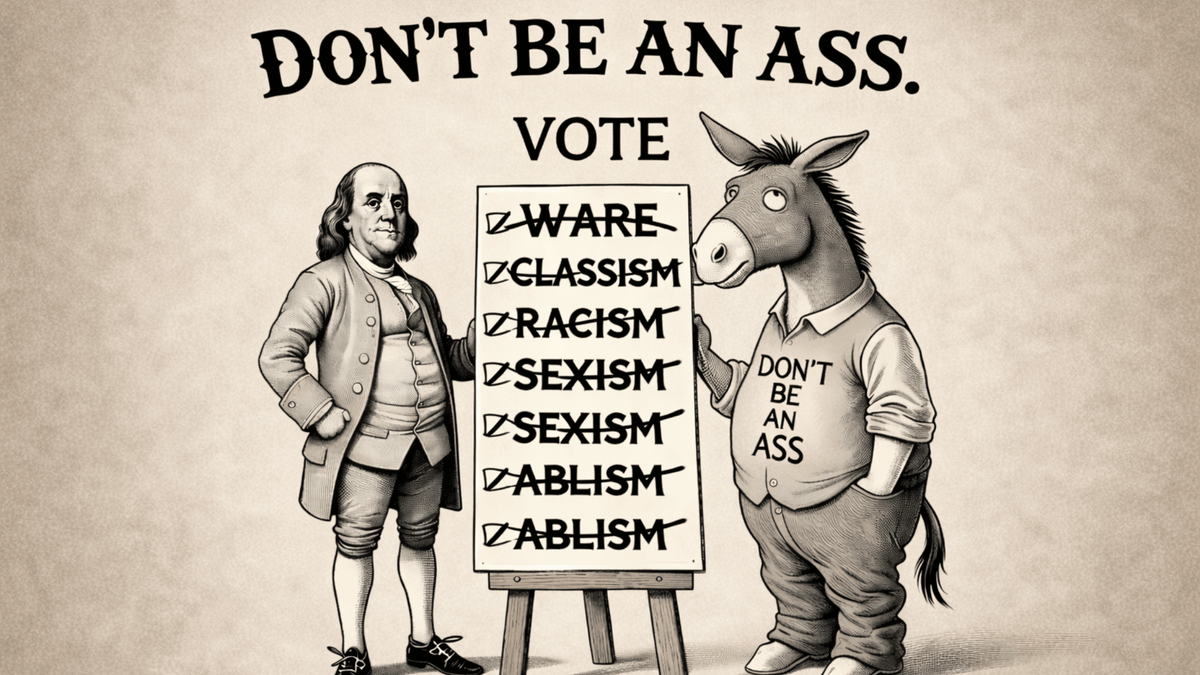
Once colonists decided to accept war and declare independence from Britain in 1776, the topic of who should vote entered the rich man / poor man dialogue and this is where Ben Franklin and his social-media worthy humor returns. From the beginning, the Founding Fathers were of different minds on who was going to vote when shaping American democracy. Only white men who owned a certain amount of property were allowed to vote; a practice inherited from England and included a small segment of the public. It's at this moment, that Benjamin Franklin emerged as one of the first suffrage heroes. Franklin led a cause to demand voting rights regardless of how much property one owned. He continued to insist that property requirements be left out of the U.S. Constitution as the men met at the convention in Philadelphia the following year. Franklin's notions of expanding voting rights to more people made the other Founding Fathers nervous. And, by today’s social media standards, it looks like Ben Franklin was good at trolling them. His famous line, known to historians as ‘Franklin’s Jackass’ follows:
“Today a man owns a jackass worth fifty dollars and he is entitled to vote; but before the next election the jackass dies. The man in the meantime has become more experienced, his knowledge of the principles of government, and his acquaintance with mankind, are more extensive, and he is therefore better qualified to make a proper selection of rulers—but the jackass is dead and the man cannot vote. Now gentlemen, pray inform me, in whom is the right of suffrage? In the man or in the jackass?”
You can judge for yourself if Ben Franklin would be worthy to trend on Twitter with #FranklinsJackass or not. In 1776, he was a major social influencer, and he is one of the first examples of an American challenging the status quo to ensure we all have the power to vote. Property ownership as a basis for citizenship and voting sounds a little bizarre by modern standards where any 18-year-old U.S. citizen can vote, regardless of wealth, gender, or race. But that was the state of the world in 1776. And Ben Franklin, one of the most influential Americans at the time, challenged the status quo. He didn’t succeed in 1776 to guarantee the vote irrespective of property ownership. Poor white men couldn’t vote for decades in early America. But what Ben Franklin succeeded in doing was to put forth a principle that every American would build upon.
The principle that the right to vote should be the source of individual power in America; and those that think otherwise will look like a jackass.
That principle and intellectual courage fueled the leaders that help earn the vote for all Americans over the next two centuries and fortified 250 years of ascending individuality and national prosperity.
When you vote, it's simple. You fill in little circles on a piece of paper or on a computer screen. It’s very low tech, it doesn’t take much time, it’s not hard. Yet, behind that simple act are the labors of generations of Americans for whom it was not easy. The Americans early on who chose to fight a war because they didn’t have the vote. And used that right to vote to settle disputes for 250 years rather than go to war. The Americans like Ben Franklin that believed the vote belonged to the rich and the poor alike. The Americans, who I look forward to writing about soon, like Susan B. Anthony and Alice Paul who believed women should vote just the same as men. The Americans like Martin Luther King, Jr and John Rock who believed the vote belonged equally to all races. And every American that came before you. You are summoning a power that has allowed Americans to reduce war, classism, racism, sexism, and ableism bit by bit and year by year. It all started in 1776. And will continue if you choose to use it. Simple, but not easy.
Voting works. Voting beats racism, sexism, ableism, classism. Voting ends poverty and promotes prosperity. Voting takes time and does not satisfy our needs for instant gratification. Martin Luther King, Jr didn’t get to see an African American become President of the United States. But it did happen. Susan B Anthony was never able to vote legally. But hundreds of millions of American women did. We vote to keep the peace so our children and grandchildren can benefit from the problems we solve, and they can solve new problems. But it is very easy to forget this simple point and the experts will never remind you. In fact, they will tell you that it’s the End of the World! But full stack voters know not to be an ass and trust that voting works better than anything ever!
#History #Voting