
250 Years of Common Sense
Society is more important than government
Do politics appear in your daily life in ways that surprise you? Does the digital world look predominantly red and blue? Have you ever thought that buying a certain product brand or liking a friend’s social media post might invoke political judgement? Whether you think this phenomenon is welcome, intrusive, or entertaining, the digital technologies of the modern public square have blurred the lines between society and government and its ok to push back or push forward, that is the privilege of any voter and the skill of a full stack voter, just make sure you know why this is happening and that it is a new addition to the public square.
On this day, January 10, of 1776, 250 years ago, Thomas Paine, a political activist wrote what would become one of the most widely read and sold American publications in U.S. history. Common Sense was a highly influential pamphlet advocating for American independence from British rule. At the time, the American colonies were embroiled in conflict with the British government, and Paine’s persuasive arguments in favor of independence resonated with many colonists. Common Sense was 47 pages and read by colonists in bars and taverns across the 13 colonies of America. It is largely regarded as the publication that prompted confidence among the American people to form their own nation and one of the earliest examples of an individual in America using their voice and the technology tools of the time to inspire action.
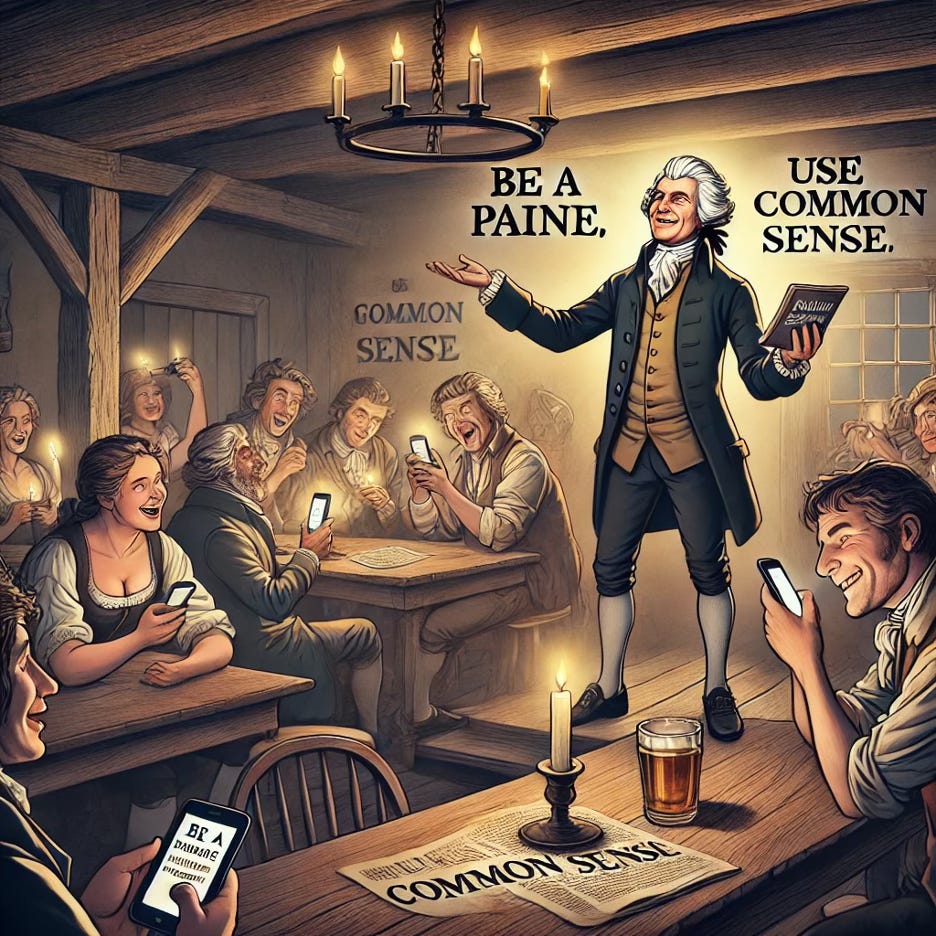
The population in America in 1776 was 2.5 million and reaching those people was challenging by today’s standards. There was limited print publications, limited literacy, and word of mouth was the primary means available for distribution. Back then word of mouth literally meant talking face to face in person. There were no phones, no video calls, no email, no telegrams. Citizens lived across hundreds of miles of territory. Today, 2.5 million followers are about how many you would need to rank as one of the top 1000 Twitter / X accounts.
In Common Sense, Thomas Paine described the idea of a small group of people isolated on an island developing their own laws and governance system to illustrate how America was separate from England and should govern itself. Paine’s argument was that people are happier and more fulfilled when they have a say in the laws that govern them, rather than being subject to the rule of a distant authority. Two hundred and fifty years later we have a democratic society founded on the principles of popular sovereignty and self-governance. The best there has ever been.
If you are a U.S. citizen, or aspire to be one, then you enjoy, or will enjoy, more freedoms and privileges than most people of the world - today or in history. Most people do not live in a society that enfranchises its citizens with individual rights above all else. Many do, most do not. Many people of the world live under some form of authoritarian regime. And authoritarians have embraced the disintermediation of individual rights in the public square through digital technology because authoritarianism extends more deeply into societal independence than in democracies.
One of the key concepts that Thomas Paine discusses in Common Sense is the difference between society and government. According to Paine, society is the natural and necessary association of people who live together and work together for their mutual benefit. Government, on the other hand, is a man-made institution that is created to serve the needs of society. Paine asserted that society is a fundamental human need and that it exists independently of government. He argued that people naturally come together in communities and form bonds of mutual aid and support, and that this is necessary for the survival and flourishing of humanity. Government, on the other hand, is a secondary institution that is created to serve the needs of society and to help maintain order and stability within it.
Paine’s distinction between society and government may seem obvious to you because in America there are many sources of authority or power. Many institutions and individuals play a role in shaping the lives of individuals and communities in the U.S.A. School systems, religious institutions, the media, political parties, special interest groups, Hollywood, Wallstreet, Silicon Valley, famous individuals from Instagram influencers to sports stars to billionaires. This idea is central to a democratic society, in which the people are sovereign and have the power to shape their own lives and destinies in a diverse society. And it is an idea that is central to understanding the Modern Public Square and Full Stack Voting. Society is more important than government. When I marvel at the greatness of America, it is American society I revere, not necessarily American government. American government is a tool of American society that often fails, that frustrates us, that must serve and protect the core of American society. And the history of American government is fraught with complicity in the world’s problems as much as the world’s success. I think this is true of any nation’s government. To be a Full Stack Voter, I believe it is critical to evaluate government’s role in serving society as it protects and empowers the individuality of its citizens, not the nationalistic or domestic policies of a given administrative or legislative tenure or aligned institution. On this front, I think the U.S. system of government – inclusive of three branches of the federal governing system and 50 state and local governing systems – is exceptional when compared to the alternatives.
I think Americans tend to take their form of government for granted and may intersperse an understanding of society and government together and I think that this is a critical subtlety to recognize as a full stack voter. In fact, you are likely to think the choice of ‘government’ I’m referring to is a choice of government run by republicans, or a government run by democrats. This is the primary competition in the United States. But that is for a government that is already run by the people. The majority of the world’s estimated 8 billion people do not live in a free society and the choice of government is not theirs to make like it is for citizens of the United States. This also means that society – and all those culture shaping institutions and individuals are not necessarily more important than their government in non-democratic nations.
According to Freedom House’s 2025 “Freedom in the World” report, which measures the level of political rights and civil liberties in countries around the world, 20% of the world’s population lives in countries that are rated as “free,” so about 1.6 billion people. These countries are generally considered to be democracies, although the specific form of government and level of democracy may vary. The United States’ 3.4 million citizens are included in this group.
Approximately 40% of the world’s population lives in countries that are rated as “partly free,” or about 3.2 billion people, meaning that they have some restrictions on political rights and civil liberties. These countries may be classified as authoritarian regimes or hybrid regimes, which combine elements of democracy and authoritarianism.
The remaining 40% of the world’s population, or about 3.2 billion people, live in countries that are rated as “not free.” These countries are generally considered to be authoritarian regimes, although the specific form of government and level of authoritarianism may vary. It is worth noting that these estimates are based on a specific definition of democracy and may not align with how some organizations or individuals define democracy. But for the purposes of this Substack, broad strokes and estimates will suffice because what they tell us is that about 80% of the world, or 6.8 billion people, don’t have the powers of freedom that you possess as a U.S. Citizen.
Back to Thomas Paine and 250 years of Common Sense. America has thrived and prospered and it is because of our society, not government. America’s power is not that it governs the most people — it’s that the most people choose it. And they can only choose it because government is a secondary institution created to serve the needs of society and the individuals within it. There are infinite amounts of brag stats on this point and why America has thrived on this basic common-sense principal. A few favorites:
1. 99.7% of all U.S. businesses are small privately owned firms in the US (property rights, due process)
2. Over 70% of the world’s most consumed entertainment content originates from the United States (free expression, property rights)
3. The United States hosts ~20% of the world’s total international migrants — more than any other country on Earth.
4. About 23–25% of U.S. adults volunteer each year — over 60 million people.
5. Nearly 60% of all global reserves and over 60% of global trade transactions are denominated in U.S. dollars.
In the digital age, the concepts of society and government as distinct is not only common sense, but also competitive differentiation. But, as mentioned in the first article on Full Stack Voting, there is a new Modern Public Square and it is changing the relationships between society and government. You likely see this regularly as described as media bias, corporate influence, academic research, tech algorithms, investing strategies, religions initiatives and is not a new phenomenon in the 21st century. But due to the personalized and competitive nature of these new technologies, it does change the incentives and transparency of how society and government intermix. Understanding, measuring and sharing those dynamics is important for full stack voting. Ultimately, I think you will find that the core principals of Thomas Paine’s Common Sense will hold true, but to point them out amidst the deeply personalized views that are forming in the Modern Public Square may feel a bit awkward and painful. But that’s ok, it is also a tradition in America to go against the grain, to be a Paine, for the sake of Common Sense.