
Introducing the Full Stack Voter
250 years of America, 25 years of a Digital Public Square
Welcome to the Full Stack Voter - A six-month essay project to celebrate 250 years of America while examining the impact of the last 25 years of digital transformation to America’s Modern Public Square
In the year 2000, Internet usage in the USA reached 51% of households, largely through something called Dial-up that transferred data at a mere 56K because only 3-5% of households had broadband Internet service. The election that year between Texas Governor George W. Bush and Vice President Al Gore was dubbed the first Internet Election with online blogs like the Drudge Report shaping news cycles and advocacy organizations like MoveOn.org gaining influence with voters. But arguably, the most important “technology” of the Public Square in the year 2000 was not digital, but physical. It was the butterfly ballot, a paper artifact, poorly designed and easily confusing voters that took center stage in an election that was so close that Americans didn’t learn who their new president would be until 39 days after election day. Newspapers and TV broadcasts showed election officials in Palm Beach County, Florida examining the ‘hanging chads’, a little piece of punched out paper that may or may not have failed to be fully punched out. Ultimately it was determined that Bush earned 537 votes more than Gore in Palm Beach, and, after a Supreme Court legal review, the winner of the 2000 campaign. In the first election of the twenty first century, the U.S. election hinged on technology that didn’t look much different than the enormous voting machines that emerged early in the 1900s or the printed paper tickets of the 1800s.
.jpg)

By comparison, in 2026, America’s 250th year, digital technology is universal and dominates the public square. 97% of the population uses the internet, with 96% of adults online and ~90% of households on high-speed broadband (100+ Mbps). Mobile access via smartphones (85%+ penetration) makes it constant and portable. In addition to digital access through the Internet, Americas experience the public square through a host of new technologies that also didn’t exist in the year 2000. Professional grade content creation tools enable anyone to produce and distribute studio quality text, audio, images and video in seconds. Digital analytics and algorithms respond to real-time behavior at the individual and aggregate level. Digital advertising and frictionless online payment technologies solicit attention and enable direct action. And we can expect that agentic and generative artificial intelligence will begin to play an increasingly active role in the elections to come.
Whether you are a political junkie, a citizen journalist, a civic minded entrepreneur or a mildly interested voter seeking reassurance that America is still a great nation, I am writing this Substack for you. I think the effect of digital commercial technology on the modern public square is a source of great ambiguity that drives extraordinary participation, existential stress, and new unexamined civic responsibilities. My view is that American citizens are born with the greatest individual power of any citizen in human history. And the infusion of 21st century technologies can turn those individual liberties into uniquely American superhero-like powers, but they are also empowering institutions and state sponsored actors to bypass and co-opt individual liberties in new ways. This may or may not be apparent to you amidst the general social cacophony that surrounds politics today or may be something that you ascribe to increased partisanship or social media. Elections have always caused anxiety and uncertainty among the U.S. population since its founding. U.S. elections have also caused anxiety in global populations as the role of United States democratic leadership has increased and endured. But something has fundamentally changed in the past decade and it’s difficult to identify it by name because the nature of this change is deeply personal and specific to each of us individually. We are all experiencing this change differently, but the underlying technology currents causing that change are uniformly understandable. As are the effects of these technologies within the armature of America’s civic machinery.
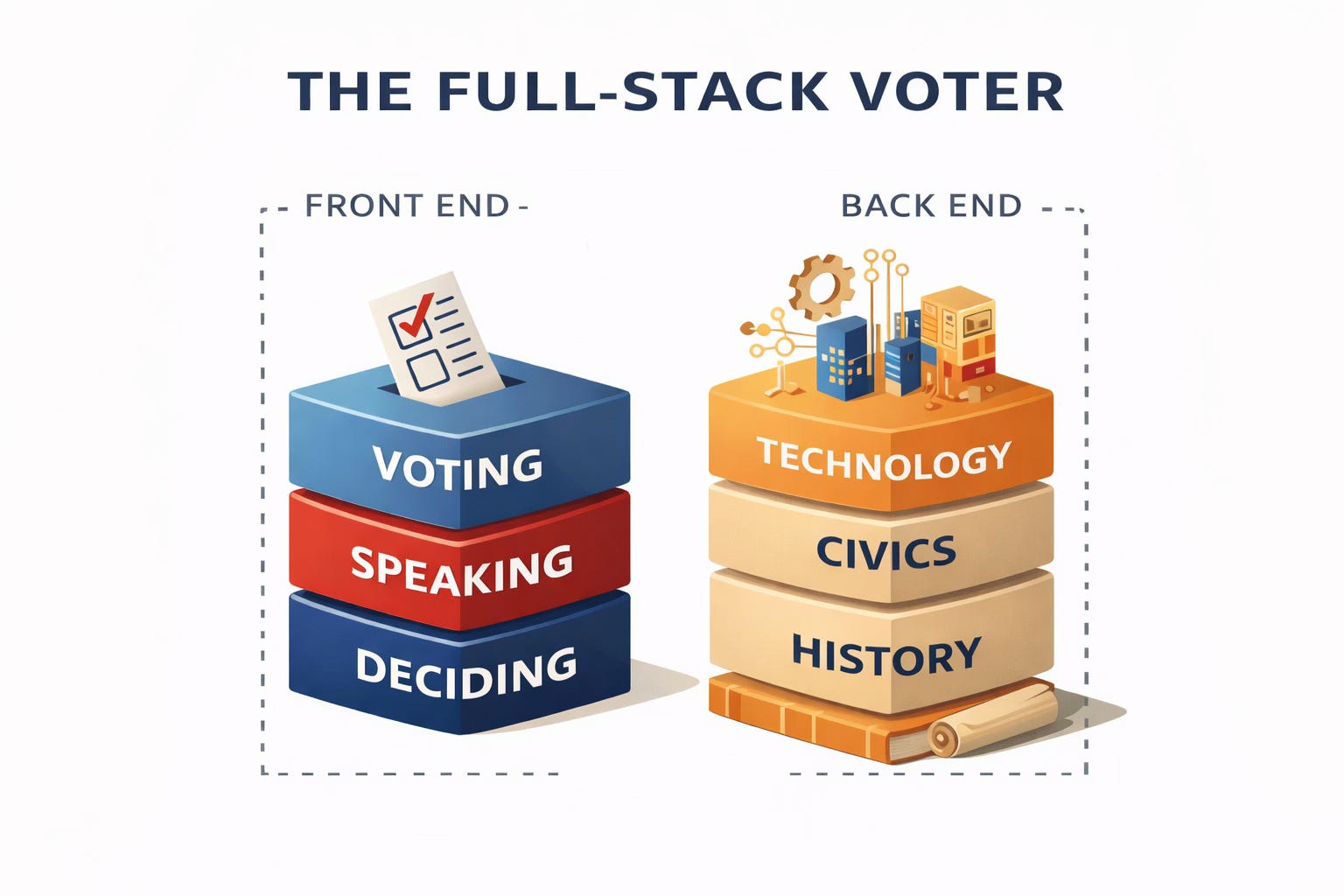
The purpose of the Full Stack Voter is to explore, analyze and understand the impact of modern technologies on American individual liberties. “Full stack” is a technology industry term that refers to a developer who can work on both the front-end (what the user sees and interacts with on a screen) and the back end (the server, database, and logic) of a software application or website. A full-stack developer is proficient in multiple technologies. A Full Stack Voter is a United States citizen, or aspiring US citizen, who seeks to master their Constitutional rights and the digital tools for the modern age in support of their own individual passions and with the confidence and fortitude of a citizen of one of the greatest societies in human history. American liberties are vast and intricate, but I will keep it simple for this Substack and group them into three categories of the front end of the ‘stack.’
The Front End
Voting is the most core and common liberty that American’s possess so it receives top line nomenclature. Americans have unusually vast and frequent voting opportunities compared with other democracies. Speaking is the liberty we all relish and associate with the First Amendment to the Constitution. The United States protects citizen speech more broadly and more absolutely than any other nation. And ‘Deciding’ who to vote for and what to say is a mashup of the myriad other liberties from due process to property rights, to equal protection to privacy to freedom of movement, assembly, press and religion. Because of the U.S. guarantees so many rights, Americans are empowered to decide where they will speak and vote on more affairs of state than any other citizen in the world. Voting, speaking and deciding are the front end of the voting stack and Americans spend their entire lives enjoying and mastering these tools of liberty.
The Backend
There is also a backend that is both new and old. The use of technology and the algorithmic literacy to understand its opportunity is increasingly critical and dynamic. The modern public square has become a digital hypermatrix of our own individual design. The Business of technology and the systems thinking required to understand its infusion is likely less understood. But it is generally understood that more money is spent in aggregate across U.S. elections than anywhere else in the world. Technology, and how it influences the public square, is a very new American civic responsibility. And of course, History and civic context of the 250-year American experiment is almost always an informative and encouraging database to the progress of American liberties and the other core component of the backend of the voting stack.